
Assumed Knowledge
Young People and Technology

I’ve been reading HBR books on Being More Productive and Getting The Right Work Done. I tried to Start With Yourself (myself), but I don’t think I’m ready for a new vision of my work and life. This is a phase I’ve been in before. The phase where everything meshes and you don’t feel like you’re nailing anything at any time. I don’t know if I will remember or apply anything I’ve read in these books, but when reading them I can picture a workday that brings a sense of accomplishment.
Going on leave from a job I have been in for almost a decade meant I had to pack up a lot of stuff before leaving. My desk was a larger version of my work bag, I felt like I needed things for any eventuation. Often hoarding things away not just for myself but for the students; anyone could need a muesli bar, or phone charger for any model of phone, or sheet of stickers. The desk and bag contained multiples of whatever any of these must haves were. Things I never needed. Nor did anyone else. When I left, I packed it all away, buying special containers with special compartments to store these things in. In the bottom of a cupboard untouched they sat until it was time to take them back, to another desk but one identical to the previous one. I vowed to take less stuff with me. I wanted empty drawers and an empty desk. In some ways I managed this but there is still a stack of books I don’t reference and a box of paperclips I never use.
The shift to digital is something that is still happening in education. Those who have been teaching for far longer than I have still cling to resources that they only have hard copies of. We are required to hang on to student work for a certain amount of time and to do so we archive it in rooms that you would only notice the doors for if you needed to find them. This isn’t a commentary on the age of some resources and the need to update but rather attention to the deep desire we all must create a nest for ourselves filled with bits and pieces we’ve picked up along the way, and in case we may need them. Even though we never will.
There is a myth that young people are good with technology. Reality is they have just developed better workarounds. This year, more than ever in any year I have taught I have come across students and situations that show a very confused understanding of the technology in their lives. Some are excuses to avoid work such as ‘I can’t use my computer because it’s charging’. Multiple times students say this to me, at first, I thought it was some joke to pull the wool over my eyes, the more I heard it the more concerned I became. Though last time a student told me this, I explained to them it was a generational ailment, this attempt to fool me into thinking that they couldn’t type on their laptops when they were plugged into charge. The student grinned, caught. Some teachers must be falling for it. Some teachers must be too tired to argue with them. Other comments highlight this lack of understanding of an area which we have labelled them natives. They don’t know how to sign in to things, download programs, reset passwords, log on to their email on another device, save things, find where they saved them, turn a computer on using the button on the back, use something to type that isn’t Google docs, download a document. The list goes on and whilst the severity and widespread nature of the items on this list vary, I assure you I am not making them up. I suggested one student send herself a document so she had a copy, but she couldn’t wrap her head around how she could then access it on a different device. It was like the scene from Zoolander when he discovers the files are in the computer, so he breaks it open to find them. Destroying the computer and the files in the process.
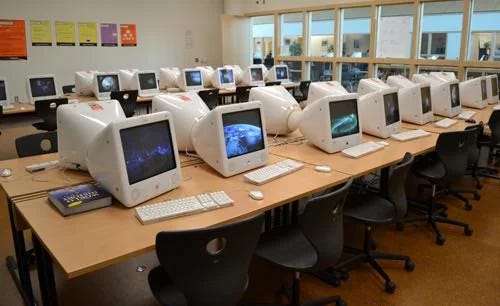
For many of the lessons I teach I find myself as an IT worker more than teacher, I am rebooting, finding USBs to back files up and guiding them through the same set of step-by-step instructions to access the wi-fi, access the learning management system, access the video editing software. I have made physical instructions and stuck them next to each computer in the room, I have made physical instructions that are laminated and can be taken off the wall and passed around, placed next to the personal device they are working on. Each year these issues persist.
What strikes me as interesting is that even if they don’t know how to do something, troubleshooting it doesn’t seem to occur to them. And perhaps why would they when I’m running around making it easy for them. But if you don’t know how to do something, the idea is that you find out, right?
This isn’t some attack on teenagers. Digital literacy is in the Australian Curriculum, but you can’t blame this on schools either. There have long been conversations about the fact that young people don’t write emails properly, but if we’re honest a lot of professionals can’t really do that either. The influx of AI just adds another facet of things people should learn to use, but appropriately, and if take advantage of otherwise it will take advantage of them but who really understands how their robot vacuum works out what it’s doing, or why mangetout by Wet Leg ends up on all of my Spotify generated playlists one way or another.
Each year I vow to introduce these digital elements differently; as if me being clearer and having more laminated pieces of paper is going to change a generation’s relationship with technology.
Learnt many technical things from you back in school, thank you 🙏❤️ It’s so silly that it’s assumed young people know how technology works. We have zero idea!!!